
If our view of U.S.–China AI competition stops at whether GPT, Claude, Kimi, or DeepSeek is stronger, I think we are staying near the surface.
Model capability matters. But the most visible contest sits above a deeper question: where is the whole AI industry heading, and how do its capabilities reach the real world?
RAND’s report makes that question more concrete. Its U.S. sample leans toward software and information work; more of its Chinese sample brings AI into robots, autonomous vehicles, and manufacturing. That makes me more interested in deployment in those environments, although this structural snapshot cannot establish which ecosystem is deploying faster.
In my earlier essay on the cross-Pacific AI chessboard, I looked at the relationships among compute, energy, engineering efficiency, and revenue. This report adds a view at the company level: which products and operating environments do those capabilities eventually reach?
AI Development in the United States and China: Evidence from a New Dataset of AI Developer Firms was published by RAND Corporation on August 17, 2026. It runs to 64 pages. I will start with its findings, then explain how I read them as a builder.
Start with the sample
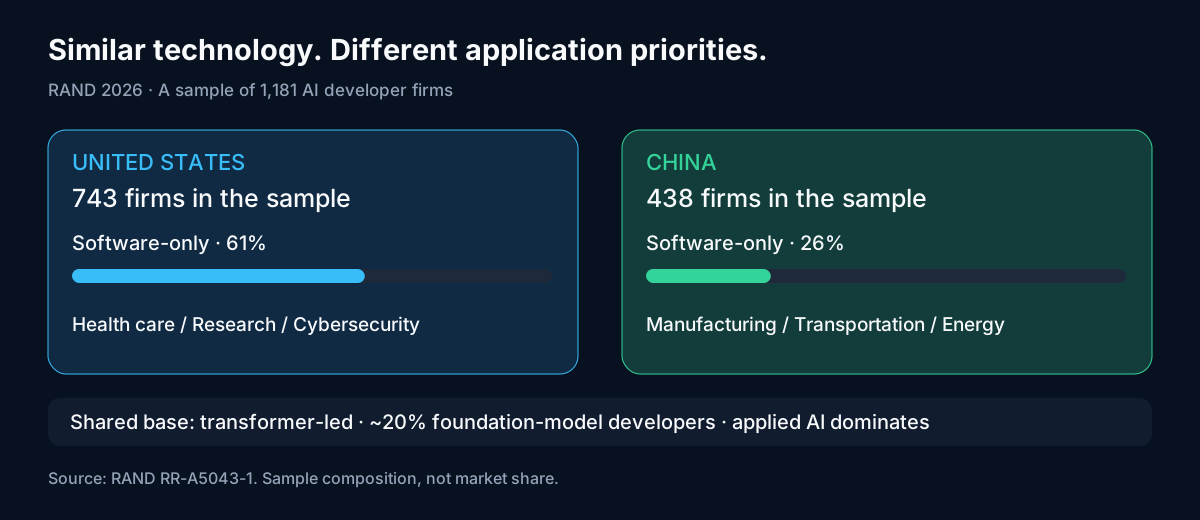
The study covers 1,181 AI developer firms: 743 in the United States and 438 in China. These firms meet the study’s selection criteria. The counts are neither a census of all AI businesses nor a ratio of national AI capability.
| Dimension | U.S. sample | Chinese sample |
|---|---|---|
| AI developer firms | 743 | 438 |
| Foundation-model developers | About 20% | About 20% |
| Leading architecture | Transformer | Transformer |
| Software-only firms | 61% | 26% |
| Embodied form factors | Less prevalent | Greater concentration in robots and autonomous vehicles |
| Application emphasis | Health care, research, cybersecurity | Manufacturing, transportation, energy |
| Main commercial orientation | Applied AI | Applied AI |
Source: RAND’s official report. These figures describe the sample, not revenue share, model performance, or global market share.
The contrast I find most useful is 61% versus 26%. Companies can use similar model technology while bringing it into very different working environments.
Similar technology, different application priorities
RAND finds considerable similarity in architecture, learning paradigms, foundation-model development, and commercial positioning. Both ecosystems are transformer-led, and most firms build applications.
Its data therefore do not support the strong claim that the United States pursues just one architecture while China explores many fundamentally different approaches.
My shorthand for the clearest difference is:
The U.S. sample leans toward software; more of the Chinese sample works in the physical world.
The emphasis matters. These are overlapping ecosystems with different concentrations. American companies also build robots, and Chinese companies also build software.
Put a similar model inside a document workspace and an industrial machine, and the constraints change. That is why I find model rankings insufficient for understanding an industry.
I care about how a system gets feedback
The following is my engineering interpretation, rather than a result RAND directly measures.
A knowledge product often starts with documents, business records, and user feedback. The system produces an answer; people review or correct it; another iteration follows. Data quality, permissions, hallucinations, latency, and cost may dominate the work.
When AI enters a machine, vehicle, or factory, output becomes action. The team must also deal with sensors, control, equipment state, exceptions on site, and recovery. Testing may require equipment, space, and people alongside software.
Connecting a model to a robot arm is only one step. Validation, delivery, and responsibility change with the operating environment.
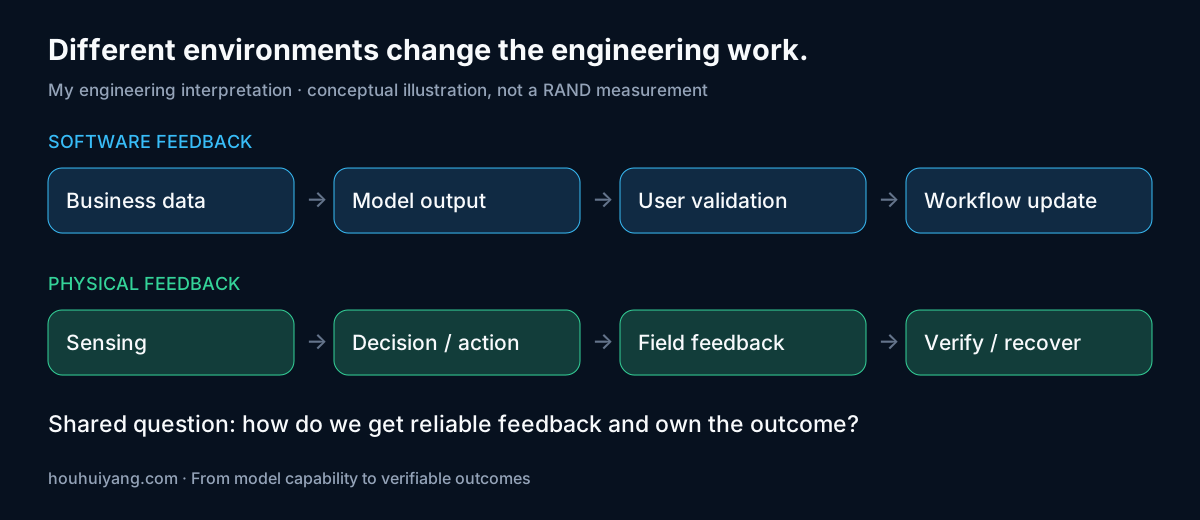
The assets a company accumulates can differ accordingly. One builds organizational knowledge, workflows, and user feedback. Another builds equipment experience, field data, and reliable operation. I care about the whole system that turns model capability into dependable results.
Embodied AI as a conditional hedge
RAND makes a conditional argument: if more general AI requires joint progress in robotics, world models, and learning from physical environments, the broader embodied portfolio in the Chinese sample could provide a technological hedge.
I read that as preparation for uncertainty about future paths. Different product directions preserve different opportunities to learn.
The condition must remain attached to the conclusion. More companies working in physical environments does not demonstrate that they already possess more general intelligence, or that embodiment will necessarily be the winning approach.
To investigate that possibility at the product level, I would ask:
- Does field data consistently feed back into training and evaluation?
- Can capabilities learned in one environment transfer to another?
- Do improvements reduce deployment, maintenance, and human intervention costs?
These are the engineering and commercial questions I would track to understand the distance between potential and delivered value.
What this means for builders
I would not change a startup’s direction to robotics simply after reading this report. A product choice still starts with a problem and an environment the team can genuinely access.
For a software team, I would look for a sufficiently deep workflow: one that produces real feedback, repeated use, and willingness to pay. Wrapping a model in a chat window does little to establish those conditions.
For a team with manufacturing or equipment experience, I would ask whether it can work on site, define acceptance criteria, and support deployment and maintenance. A successful demonstration and reliable long-term operation impose different demands.
I would assess both kinds of opportunity through the same questions:
| Question | What I want to establish |
|---|---|
| How is the task done today? | A specific, recurring problem |
| Which outcome is worth paying for? | Value that can be verified |
| Where does the data come from? | Lawful, continuing access to feedback |
| Who takes over when the system fails? | Clear delivery responsibility |
| How do costs change with each customer? | A path from projects to a repeatable product |
These are my product judgments extending from the report. An industry pattern can suggest where to investigate; each opportunity still needs its own evidence.
The company list is a starting point
RAND also provides an Annex containing company names. I would use it as an index for further research into products, customers, delivery methods, and data sources.
My next pass would organize observations around foundation models, agents, robotics, autonomous driving, health care, research, cybersecurity, and manufacturing. That is a proposed research lens, not a classification I have already completed or one the annex promises to provide.
The study also has boundaries. Its data mainly capture January–February 2026, rely on public information, and have more missing information for Chinese firms. Universities and government research organizations are outside its commercial-firm scope. Publication in August does not make it a live view of August’s industry.
I see it as a bounded map: useful for asking better questions, followed by verification at the company level.
Look beneath the model rankings
To understand AI, I want to examine five things together:
- Industry: Which sectors and production processes are changing?
- Capital: Is funding supporting research, customer acquisition, or equipment deployment? Can revenue sustain further investment?
- Talent: Can model researchers, software engineers, control engineers, and domain experts work effectively together?
- Supply chains: Which dependencies, from chips and sensors to equipment and maintenance, determine costs and delivery?
- Real applications: How many systems have moved beyond demonstrations into customers’ daily operations?
This is my broader framework for following the industry, not a set of findings RAND has established across all five dimensions. Benchmarks answer some capability questions; they leave these delivery questions open.
What I take away
Similar technology can lead to very different products. Where a model operates shapes the data a company needs, the engineering work it must do, and how it earns revenue.
For me, the report is a reason to spend more time looking beyond a few prominent models and into actual products and operating environments.
The future contest may extend beyond whose model is smarter to who can bring AI more deeply into the real world.
That world includes information work in hospitals, research institutions, and businesses. What matters to me is whether capability reaches an operating workflow, produces continuing feedback, and comes with responsibility for the outcome.
References
- RAND report page and Annex download
- Full report PDF: AI Development in the United States and China, Jon Schmid, Prateek Puri, Vitor Melo, and Anthony Hakim, 2026. Firm counts appear in Table 3.1; the summary covers the main findings and limitations.
The illustrations are my own diagrams based on the report’s figures and my interpretation, not reproductions of RAND graphics.