
I recently read a letter from Dimension Capital to its limited partners titled The Cross-Pacific AI Chessboard.
It appears to be an essay about U.S.–China AI competition. Its real value, however, is not another prediction about which country will win or another ranking of frontier models. It decomposes AI competition into a coupled system: models, chips, power, engineering efficiency, open weights, data, inference, commercial revenue, and capital markets.
That is much closer to how I understand the AI industry.
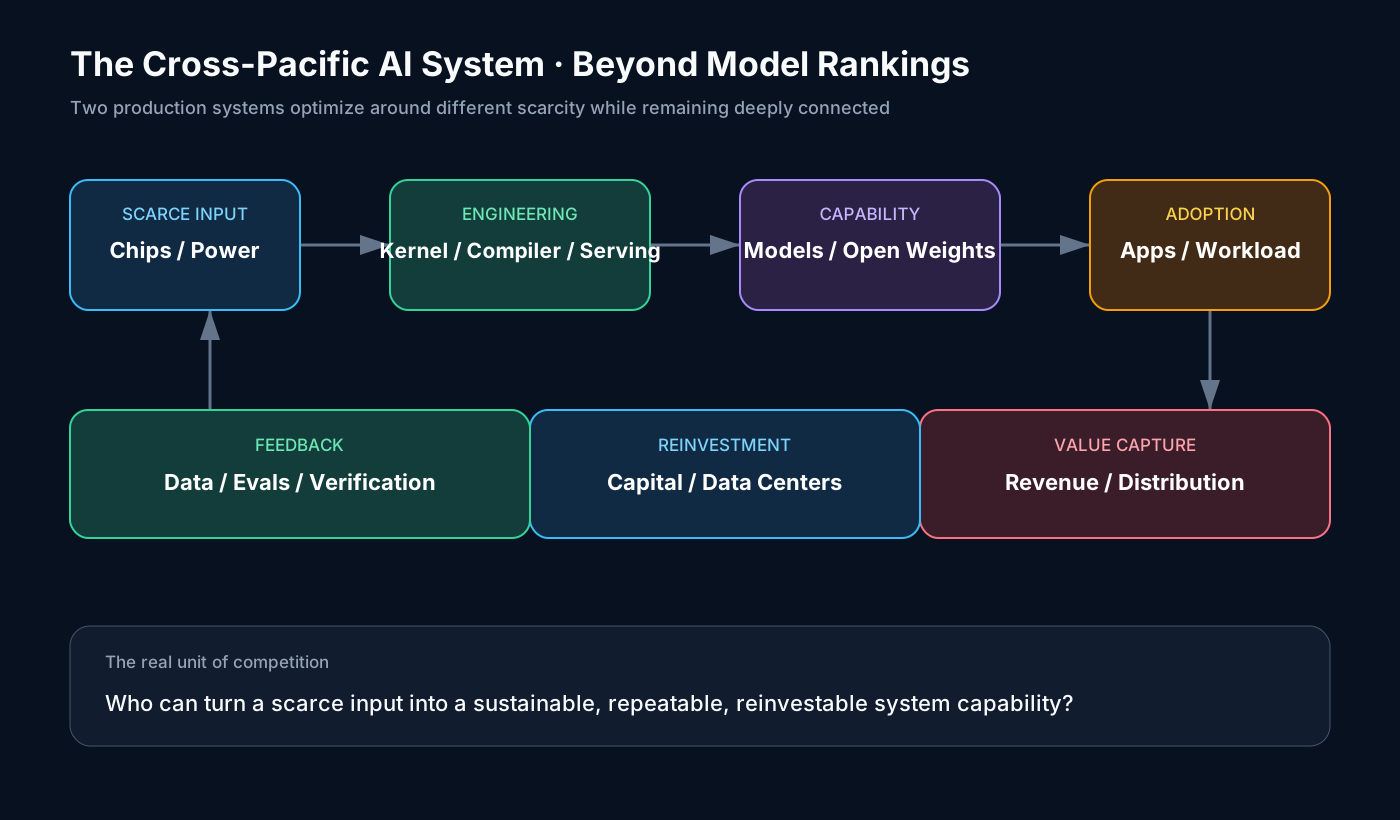
For the past two years, we have often watched one simple coordinate: who scores higher, who trains the larger model, and who releases the next capability first. A model is only the most visible layer. Whether that capability can be trained, deployed, adopted in production, monetized, and converted into the next round of compute depends on whether the whole loop closes.
My central conclusion is:
U.S.–China AI competition is no longer a model race. It is a competition between two production systems shaped by different forms of scarcity.
Scarcity changes technical culture
Dimension's first argument is that scarcity drives evolution. Export controls reduced Chinese labs' access to advanced compute and pushed optimization deeper into the stack: from model architecture into optimizers, compilers, kernels, PTX, serving systems, and even chips and interconnects.
I agree with the observation, but I would phrase the mechanism more carefully. Scarcity does not automatically create innovation; it can also stop a team. Change happens when the target cannot be reduced and resources cannot grow linearly, forcing an engineering organization to redefine what is worth optimizing.
In a compute-rich environment, adding GPUs may produce the highest marginal return. In a constrained environment, removing a memory transfer, raising utilization, or cutting inference cost may matter more than scaling the model.
Over time, the default actions diverge:
relative abundance → scale the system → push the capability frontier
relative scarcity  → extract efficiency → maximize output per unit of compute
This is not a difference in intelligence. It is a difference in objective functions. Technical culture is often created by the bottleneck that actually blocks delivery every quarter.
China is gaining workload without equivalent revenue
The most memorable line in the memo is that Chinese models are gaining Western workload, but not equivalent Western revenue.
Open weights change the path into production. Traditional enterprise software requires vendor review, procurement, data agreements, and long-term service commitments. A model that can be downloaded, fine-tuned, and deployed on a company's own infrastructure may be adopted by engineers before it becomes an official dependency.
That helps explain why Qwen, DeepSeek, Kimi, and GLM can quickly enter overseas developer tools, agents, and inference platforms. What spreads is capability, not a SaaS seat.
Workload, however, is not revenue. Value may stay with several other layers:
- the cloud selling GPUs or inference tokens;
- the application company wrapping the model in a workflow;
- the platform owning enterprise distribution;
- the data, evaluation, and verification infrastructure;
- and only then, perhaps, the model developer.
Open weights can compress the price of the model layer without compressing the value of the entire application chain. They are more likely to redistribute it: model capability becomes commoditized while deployment, distribution, proprietary data, and business loops gain bargaining power.
“Chinese models are widely used” and “Chinese model companies have strong commercialization” are therefore separate claims. Technical penetration is not a substitute for revenue quality.
Capability can cross the Pacific twice
Dimension describes a striking loop:
U.S. frontier model
  → distillation and engineering in a Chinese lab
  → open-weight model
  → adoption by a U.S. application company
  → sale to U.S. enterprise customers
Add data, GPUs, and overseas data centers, and the chain becomes even more complex. A Chinese team may rent NVIDIA compute in Southeast Asia, absorb capabilities from a U.S. frontier system, release open weights through global inference providers, and ultimately enter another American company's production stack.
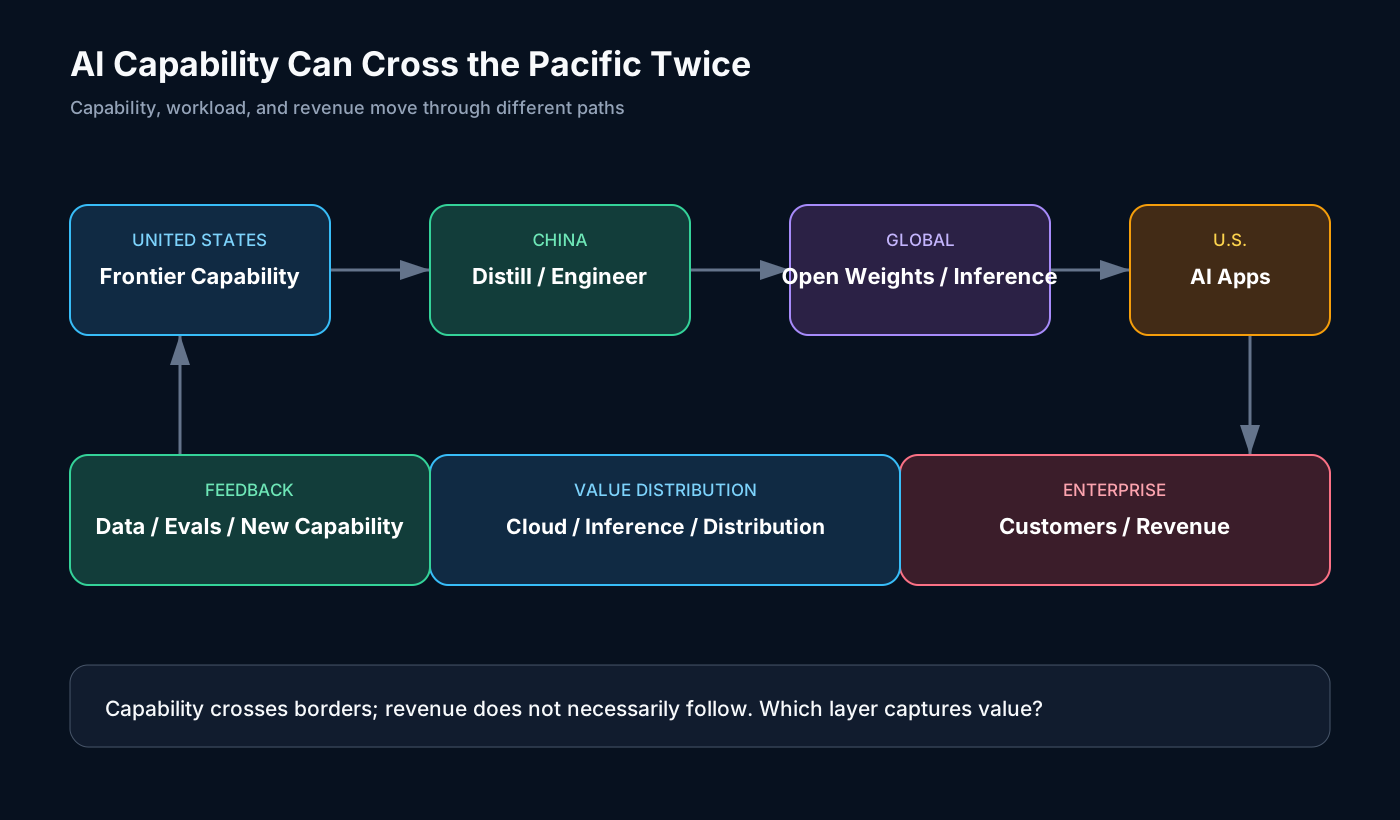
This makes “American model” and “Chinese model” increasingly coarse labels. The research organization has a nationality; the actual capability chain crosses hardware, data, training, distillation, deployment, and application markets.
Policy can change cost and speed, but cutting one edge rarely stops a network. Complex systems search for substitutes: remote compute, third-country data centers, open weights, model routing, distillation, synthetic data, and new suppliers reconnect broken paths.
The important question is no longer whether a connection exists. It is who pays for the connection, where revenue settles, and who controls the nodes with bargaining power.
The United States is constrained by power; China by chips
The memo compresses the opposing constraints into a useful contrast: the United States has greater access to advanced chips but faces increasing limits in power, data-center space, and grid construction. China can expand power infrastructure faster but remains constrained by advanced GPUs, manufacturing yield, and packaging.
This is more useful than asking which side has more compute, because compute is not one variable:
effective compute = chips × power × network × data center × software efficiency × uptime
If any factor approaches zero, expensive accelerators become underused inventory. Abundant electricity does not automatically become training capacity either; it still requires chips, interconnects, a software stack, and an engineering organization.
Both systems are trying to substitute around their shortage. The United States uses energy contracts, dedicated data centers, and more efficient models to soften its power constraint. China uses domestic accelerators, cluster engineering, compression, and an open ecosystem to soften the advanced-GPU constraint.
The decisive variable is not simply the size of an advantage. It is how quickly each system can reduce the force of its scarcest input.
Capability and revenue are not moving on the same curve
Dimension also argues that the commercial revenue gap is much larger than the model-capability gap. The memo cites annualized revenue estimates for OpenAI, Anthropic, and Chinese model companies. These numbers come from private-market reporting and industry conversations with inconsistent definitions, so I treat them as directional signals rather than audited statements.
The structural difference is visible without relying on an exact number.
Leading U.S. labs operate in a more mature market for enterprise software, APIs, developer distribution, and capital. Revenue buys compute, talent, and data-center commitments, which support the next generation of models. China has enormous user reach and rapidly diffusing open models, but consumer willingness to pay, enterprise contract sizes, and value capture at the model layer remain weaker.
This produces two different loops:
high revenue → more compute → stronger models → higher-value products → high revenue

open weights → more adoption → more feedback and ecosystem → lower model price → more adoption
The first loop concentrates capital and pushes the capability ceiling. The second diffuses capability and lowers adoption barriers. The future depends on whether each can solve its weakness: whether closed, high-value models can cover rising infrastructure costs, and whether an open ecosystem can convert usage into sustainable revenue.
The real competition is between incentive systems
Put DeepSeek, Qwen, Kimi, Doubao, and GLM in one frame and the intensity of competition inside China may be more immediate than the abstraction of national competition. Teams face product cadence, inference cost, model rankings, user growth, and financing before they face a grand geopolitical narrative.
American labs are shaped by their own incentives as well: API revenue, enterprise customers, capital expenditure, compute contracts, and safety commitments influence whether models are opened, when capabilities ship, and how access is priced.
States define constraints. Companies and research organizations optimize within them. The resulting ecosystem often emerges from accumulated locally rational decisions, not a centrally designed blueprint.
That is why I do not think of this as two players on a chessboard. It looks more like two deeply connected markets with intense internal competition and mutual dependence through models, hardware, data, and revenue.
The important part of RSI is verification
The later part of the memo discusses a weaker form of recursive self-improvement: models participating in their own research, coding, experimentation, and iteration.
I prefer to call this compression of the R&D loop rather than immediately invoking the stronger imagination attached to RSI. Models can already generate experiment code, analyze failures, propose candidates, assist data selection, and automate evaluation. They still depend on humans to define objectives, design verification, and bear the cost of error.
The scarce resource may not be compute alone. It may be high-quality verification:
- Is the result actually better than the baseline?
- Did the gain come from data leakage?
- Does the capability reproduce on real work?
- Did safety, cost, or latency deteriorate?
- Who decides that an automated experiment deserves another round?
If self-improvement is mainly compute-bound, the U.S. advantage looks stronger. If it is verification-, engineering-, or experiment-throughput-bound, China's efficiency culture and open collaboration may matter more.
Models can produce answers faster. The system must become better at deciding which answers are true.
What I took from the memo
First, scarcity determines the direction of optimization. Shortages of chips, power, revenue, and verification capacity create different R&D cultures.
Second, capability flow has separated from value capture. A model from one country can serve another country's workload while revenue remains in cloud, inference, applications, and distribution.
Third, system competition cannot be explained by one metric. Model rankings, GPU counts, generation capacity, users, and valuations are each only one layer. What matters is whether they form a sustainable feedback loop.
Dimension's letter has an explicit investment perspective, and some claims about penetration, revenue, and model provenance need independent verification. Its analytical framework is still worth keeping: the U.S. and Chinese AI systems are deeply entangled, and competition no longer runs along one straight line.
I do not expect a simple winner. Model capability will probably continue to cross borders; infrastructure will become more regional; open and closed systems will coexist; and value will keep shifting among models, compute, data, applications, and distribution.
The signal worth watching is not who leads one benchmark. It is who turns a scarce input into an engineering capability that others cannot easily reproduce.