
What fascinates me about science is not only that it keeps producing answers. Just when we think the world has been explained, science opens a larger crack in the picture.
Quantum entanglement tells us that separation does not necessarily mean independence. Black-hole physics makes us rethink spacetime in terms of information, entropy, and computation. The James Webb Space Telescope keeps placing objects before us that seem to have appeared too early in cosmic history.
None of this proves that people share a quantum connection. It does not prove that we inhabit a virtual world, and it does not place qi inside established physics. Still, it makes me take three conjectures seriously:
- A human bond may resemble entanglement: once something real has happened between two people, distance alone cannot erase it.
- Reality may fundamentally be an information-processing environment, with black holes as its most extreme quantum information systems.
- What Chinese tradition calls zhenqi, or vital qi, may name a genuine state created by the body, breath, attention, and consciousness—even if we lack a precise scientific language for it.
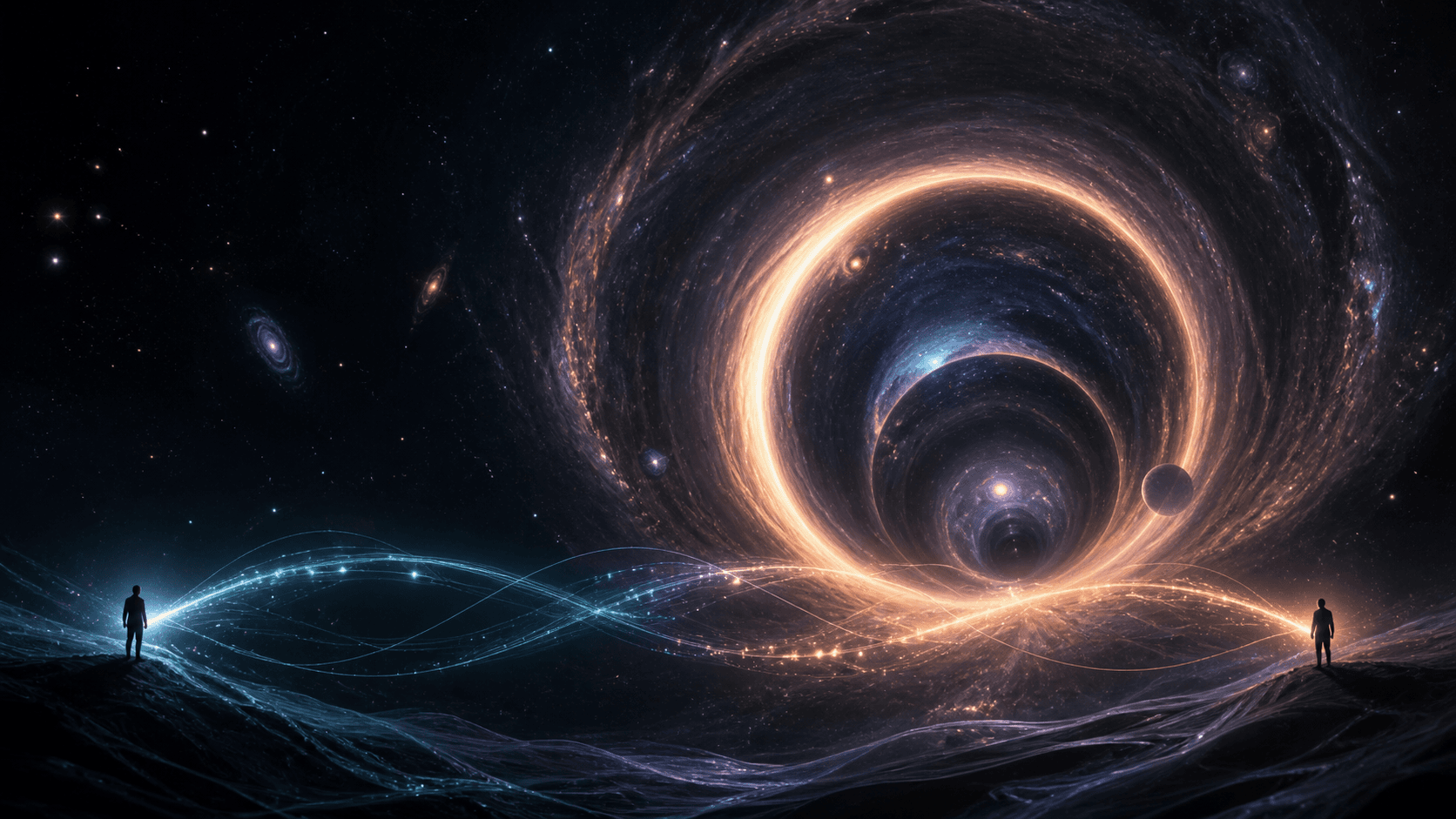
This essay is not a scientific conclusion. It is a personal reflection written at the boundary of what science currently knows.
Entanglement: distance cannot undo an established relationship
Quantum entanglement is often paraphrased carelessly: no matter how far two particles are separated, changing one makes the other instantly “feel” it and receive a message.
The more accurate account is that an entangled pair must be described as one quantum system. Measurements made far apart produce correlations that classical local theories cannot explain. The Bell-inequality experiments recognized by the 2022 Nobel Prize in Physics established that these correlations cannot be reduced to a simple theory of local hidden variables.
Entanglement does not, however, let us send a controllable message faster than light. Each observer sees random results locally. The correlation becomes visible only after the observers compare their data through an ordinary communication channel.
That distinction matters. Physical entanglement is not telepathy, and it does not prove destiny between people.
Yet the metaphor still moves me.
When two people truly meet, they create a shared history that cannot be reduced to two isolated individuals. A sentence, an act of trust, or a period of working side by side changes how both people later see the world. They may become distant and rarely speak, but the shared experience has already entered their memories, choices, and character.
For me, destiny is not a mysterious force transmitting signals across space. It is something simpler and deeper:
Once two people have genuinely participated in each other's lives, they have changed each other's initial conditions. Distance can interrupt communication, but it cannot remove an event from history.
I use entanglement as a metaphor for human connection not because the two are physically identical, but because it reminds me that isolated objects may not be the only fundamental ingredients of reality. Relationships can be real too.
Webb is showing us a universe that matured too soon
The familiar story of cosmic evolution runs roughly like this: after the big bang, matter cooled; the first stars and small galaxies formed; structures merged and accreted over long periods; only then did the enormous galaxies and supermassive black holes of the later universe emerge.
Webb has not demolished that story, but it has made the story much less comfortable.
It has found abundant, bright, and compact objects only a few hundred million years after the big bang. Some early galaxies appear brighter, more massive, or more structurally developed than earlier models led us to expect. Some black holes appear too early and grow too quickly. The problem may not be the hot early phase described by big-bang cosmology. It may be our incomplete account of how the first galaxies and black holes formed after it.
The “Little Red Dots” are among the most striking puzzles. They are abundant during roughly the first 1.5 billion years of cosmic history. Interpretations have ranged from compact young galaxies and dust to active black holes. New deep spectroscopy now points some of them toward a stranger picture: a supermassive black hole wrapped in a hot, dense, partially ionized gas cocoon—the “black hole star” model.
In 2026, Webb identified more than forty spectral lines in GLIMPSE-17775. Multiple independent features support the interpretation of a rapidly accreting black hole hidden inside dense gas. Research on another Little Red Dot, Abell2744-QSO1, adds evidence that some supermassive black holes may have become enormous before a mature host galaxy existed around them.
What these observations challenge most directly may be the sequence we took for granted:
old intuition:
small galaxy → stellar death → small black holes → slow growth into a supermassive black hole

new possibility:
direct collapse of dense gas → massive black-hole seed → black hole and galaxy co-evolve
Webb has pushed our sight closer to cosmic birth. It is not showing a standard model overturned overnight. It is making the blank spaces in that model begin to glow.
Could we live inside a black hole?
Black-hole cosmology proposes a bold possibility: the interior of a black hole may not terminate in a physically infinite singularity. In models involving torsion, quantum gravity, or other high-density effects, collapsing matter could bounce at an extreme but finite density and create a new expanding spacetime.
If such a model is correct, an observer in a parent universe sees matter collapse into a black hole. An observer on the inside may instead experience something like the birth and expansion of a universe.
parent universe
  ↓ gravitational collapse
black hole and event horizon
  ↓ singularity avoided by a high-density bounce (hypothesis)
expanding child universe
  ↓ stars and new black holes form
more child universes (further conjecture)
The event horizon causally separates the two regions. Even if we lived inside a black hole, we would not expect to look outward and see the parent universe. From outside, the object is a black hole. From within, space might be vast and continue expanding.
What attracts me to this theory is the way it rewrites the big bang from creation out of nothing into inheritance. Our universe may not be an absolute beginning. It might be the interior continuation of a collapse elsewhere. Universes produce black holes; black holes may produce universes; reality becomes a branching lineage.
The boundary must be explicit: there is currently no observational proof that our universe is inside a black hole. Webb's early black holes and Little Red Dots do not directly confirm black-hole cosmology. The defensible connection is that new anomalies can make neglected theories worth discussing again—not that the anomalies have proved them.
Is a black hole a quantum computer?
If computation means physical states evolving by rules and thereby processing information, a black hole looks like one of nature's most extreme information systems.
Black-hole entropy is related to event-horizon area. How information that falls in is preserved, scrambled, and perhaps returned through Hawking radiation remains one of the deepest questions in physics. Quantum-information researchers describe black holes as extraordinarily fast scramblers and study them through the language of quantum circuits, entanglement, and error correction.
So when I say “a black hole is a quantum computer,” I do not mean that it contains chips, software, and a screen. I mean something more precise:
A black hole may compress matter, energy, spacetime, and quantum information into one physical process. It is not a manufactured computer, but it can be understood as a system that processes information under quantum rules.
One step further lies the question of whether the universe itself is a computation. Some theoretical programs treat spacetime as emerging from deeper quantum information processing. If space, time, and matter are all internal states of a system, what we call reality may indeed resemble an enormous runtime environment.
But “computational” does not mean “simulated by a programmer.” The simulation hypothesis has no decisive evidence, and it is difficult to formulate a test that distinguishes it from ordinary physical law.
When I call reality virtual, I do not mean that it is fake. I mean:
The reality we experience may be an interface presented to observers by deeper rules.
A table remains solid. Love remains real. Choices continue to have consequences. Even if reality is made of information, life loses none of its meaning. A character inside a game does not perceive the transistor, but its level still has stable rules. In the same way, our inability to see the lowest layer of reality does not make our own layer unreal.
Qi: perhaps not a particle, but a whole-body state
I believe that what people call zhenqi—vital qi—is real.
I do not need to claim that it is an undiscovered elementary particle. Nor do I think every unexplained sensation can be labeled “energy.”
During deep breathing, concentrated attention, relaxation, or sustained practice, people can genuinely experience warmth, flow, fullness, vibration, or a current moving through the body. Modern physiology can approach these experiences from several directions: breathing changes autonomic regulation, posture changes muscle tension and circulation, attention amplifies interoception, and training improves our ability to discriminate internal signals.
Those explanations do not erase the experience. They give it a bodily foundation.
I prefer to understand qi as an old, compressed name for a complex system state:
breathing rhythm
+ nervous-system state
+ circulation and muscle tension
+ interoception
+ attention and emotion
+ learned movement patterns
= the whole lived state experienced as “qi”
Modern science tends to divide a system into variables. Traditional practice often begins with the whole sensation. The two languages may point toward the same embodied person from different directions.
Current evidence does not establish a separate qi energy that can be independently measured, detached from these physiological processes, and transmitted between bodies. I have to acknowledge that boundary. But I am equally unwilling to declare a lived experience worthless simply because it does not yet have a dedicated instrument reading.
For me, qi is first a trainable and perceptible dimension of living that changes the quality of action. Future science may decompose much of it into couplings among nerves, breathing, fascia, circulation, and consciousness. Some of it may remain part of the first-person language of being alive.
The three conjectures ask one question
Entanglement asks whether relationship can be more fundamental than distance.
Black-hole cosmology asks whether an ending can also be another beginning.
Qi asks whether life can be fully explained after it has been separated into parts.
These ideas operate at entirely different scales and have no demonstrated causal link. I place them together not to invent a “quantum mystical theory of everything,” but because each challenges an overly simple intuition: that individuals are isolated, that the universe has only one absolute beginning, and that a body is nothing more than the sum of its components.
My view can be condensed into three statements:
Destiny is not quantum entanglement, but entanglement changes how I understand relationship.
Black holes have not been shown to give birth to universes, but they offer another way to imagine what came before our big bang.
Qi has not been established as an independent physical energy, but the human experience of inner vitality is real, worthy of study, and worthy of respect.
The purpose of science is not to stamp every unknown as superstition. The purpose of imagination is not to package every hope as “scientifically proven.” The difficult and fascinating place is between them.
I want to preserve doubt, and I want to preserve wonder.
Perhaps we will one day discover that cosmos, life, and consciousness are different-scale expressions of one immense information process. Perhaps we will not.
As long as we keep observing carefully, distinguish evidence from belief honestly, and learn to ask better questions, the exploration itself already has meaning.
Further reading
- The 2022 Nobel Prize in Physics: entangled photons, Bell inequalities, and quantum information science
- NASA: Webb reveals a black hole that formed before its galaxy
- NASA: Webb finds the strongest evidence yet for “black hole stars”
- Nikodem Popławski: The Universe as a Black Hole in Isotropic Coordinates
- Seth Lloyd: A Theory of Quantum Gravity Based on Quantum Computation