
After years of working in technology, I increasingly believe that a career cannot be explained by a simple choice between stability and job-hopping.
What a person earns depends on capability, but also on industry cycles, location, platform, team, and stage of life. Effort matters. The time and place in which that effort is applied matter just as much.
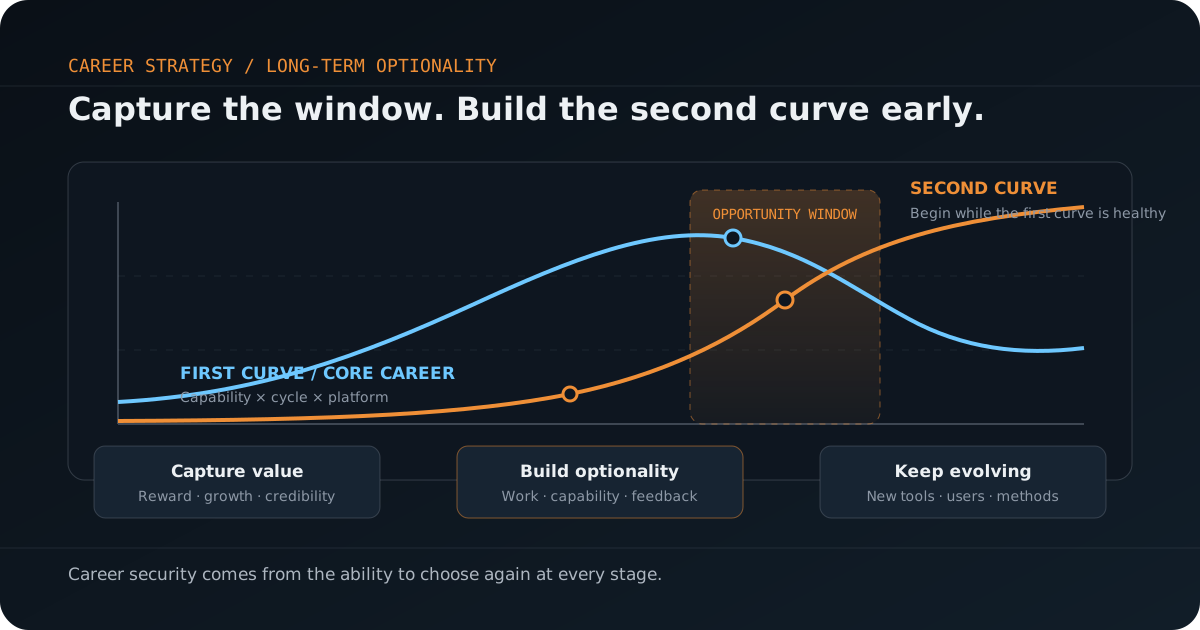
I have condensed my thinking into three principles: capture value during your window of opportunity, design a second curve before you need it, and keep learning how the world is changing.
Capture your value when timing, position, and people align
Every industry has a window. Every person has one too.
During the rapid expansion of the mobile internet, software engineers were scarce. For many people, changing companies roughly every two years was an effective way to increase compensation, responsibility, and technical exposure. The value did not come from changing jobs for its own sake. It came from a market willing to pay more for a scarce capability.
There is no universal formula, however.
If you are inside an exceptional company whose business is growing, whose team deserves trust, and where you can take on greater responsibility and share the upside through equity, long-term incentives, or organizational growth, staying may create far more value than frequent moves. During Tencent's high-growth years, some people who stayed and grew with the company earned returns that salary alone could never have produced.
The opposite is also true. If a small or medium-sized company has limited growth, management continuously drains people, and the owner demands loyalty while refusing to share results, “stability” may simply mean selling your most valuable years too cheaply.
My principle is straightforward:
Within the boundaries of law, professional ethics, and long-term credibility, choose the path that best fits you and maximizes your long-term interests.
Those interests include more than this year's salary. They include capability, industry position, health, family responsibilities, transferable relationships, visible work, and future options.
Do not switch jobs mechanically for a small raise. Do not stay indefinitely because of habit, fear, or a founder's distant promise. Ask instead: Is this platform still amplifying me, or has it begun to consume me? Am I sharing in the growth, or only carrying its cost?
Build the second curve before the first one fails
In a rising economy, people easily overestimate the stability of a job. In a downturn, organizations recalculate costs with little sentiment.
Software engineers are particularly vulnerable to one illusion: if the technical work remains solid and delivery continues inside one company, the career will naturally continue. Yet a title, internal authority, and recognition often belong partly to the organization. When the role disappears, they do not always convert directly into value in the external market.
If an experienced engineer waits until a layoff to update a résumé, study the market, learn new technology, and search for a new professional identity, every source of pressure arrives at once. The anxiety is not only about being between jobs. It comes from having one income curve, one professional identity, and one way for the market to price you.
A second curve should therefore not be an emergency response. It should begin while the primary career is still healthy.
It does not necessarily mean quitting to start a company, and it is not the same as finding a random side hustle. A second curve might mean:
- developing AI, product, data, or management capability beyond the primary stack;
- writing, contributing to open source, and turning experience into visible work;
- joining real projects that create a delivery record independent of the current employer;
- building a small loop around consulting, teaching, tools, content, or a product;
- maintaining trusted relationships across companies, industries, and age groups;
- becoming independently known for solving a specific class of problems.
The second curve is usually weak at first. Its immediate return may be far below the main job. Its purpose is to stop capability, reputation, and income from being completely tied to one organization.
The first curve provides today's certainty. The second curve protects tomorrow's options.
When conditions change, a person with a second curve may still feel anxious, but does not start from zero. There is visible work, market feedback, a different combination of capabilities, and an understanding of how the world outside the current company assigns value.
Use weekends to evolve, not to exhaust yourself
I believe in learning during weekends. I do not believe every hour of rest should become a second shift.
Continuous evolution is not an occasional all-night sprint through a new framework. It is a sustainable rhythm: reserving a few hours each week to read, practice, write, talk with people, or build something small and real.
This matters especially now. AI is changing how knowledge is acquired, code is written, products are built, and organizations collaborate. Much of our experience remains valuable, but experience that cannot combine with new tools and contexts can harden into a constraint.
Beyond technology, I also try to understand what younger people think, what they use, and why they make different choices.
The goal is not to imitate them or chase every trend. It is to avoid explaining the present only through the experience that made us successful in the past. Younger people's media habits, tools, consumption patterns, expectations of work, and styles of expression often reveal new product opportunities and organizational shifts early.
Remaining young in a useful sense is not about adopting fashionable language. It is about staying curious about unfamiliar things and accepting that one's knowledge structure must continue to change.
Treat a career as a system you actively design
Career security is not the same as having a long-term contract or spending enough years in one company.
More durable security comes from capabilities that work across environments: solving real problems, making outcomes visible to the market, recombining resources after a platform changes, carrying enough buffer through an income interruption, and continuing to collaborate with people from different generations and backgrounds.
If I treat a career as a system, I keep returning to four questions:
- Window: Is my industry and role expanding, maturing, or contracting?
- Value: Does the current platform reward me in proportion to the responsibility and results I create?
- Curve: Beyond my current job, am I building another capability and identity that the market needs?
- Renewal: Am I still engaging with new tools, a new generation of users, and new ways of working?
These questions have no permanent answers. Life stages change, family responsibilities change, and industries move through cycles. The goal is not to make the correct choice every time. It is to avoid handing your ability to choose entirely to one company, one manager, or one skill.
Closing thought
Looking back, the greatest career regret is often not missing one salary increase. It is failing to assess your value during the years when your window was open. The deepest risk is not losing a job on one difficult day. It is making no preparation while everything still appears stable.
When it is time to advance, advance. When capability, market momentum, and personal circumstances align, ask for fair value. Do not use cheap versions of “loyalty” to comfort yourself.
When it is time to accumulate, be patient. A second curve rarely produces impressive returns at the beginning. Over time, however, it turns anxiety into preparation and passive waiting into active choice.
Learning connects both curves. Weekend reading, practice, building, and conversation are not meant to keep us permanently busy. They help us understand a changing world, remain able to participate in it, and retain the capacity to begin again.
The best career strategy is not predicting which company will remain safe forever. It is building the ability to choose again at every stage.