
Whenever I set up a new computer, I restore the development environment first: GoLand, IntelliJ IDEA, VS Code, multiple JDKs, Python, Node.js, MySQL, Redis, Docker, Postman. For years, that ritual took two or three days and felt like part of being an engineer.
This time I stopped halfway through.
When had I last opened GoLand? Or IntelliJ? I was still building software, so why had the tools that once defined my productivity stopped being my primary entry point?
The answer was not that coding had disappeared. The structure of the work had changed. I increasingly described the outcome, supplied context, reviewed a plan, and verified the result. An agent explored the repository, changed the code, ran the tests, and handled repetitive execution. Languages and frameworks still mattered, but they were moving from tools I had to operate personally to environments I had to understand and judge.
The change was not the IDE. It was the basic unit of work.
The same shift will not remain confined to engineering. Once AI can interpret context, use tools, execute multi-step tasks, and revise a plan based on results, the organizational question is no longer “Should we give employees an AI assistant?” It becomes:
How should we redesign a team when AI can participate as an execution unit?
AI-enabled is not AI-native
Many AI transformations begin with software procurement and end there. Meeting notes are summarized, marketing copy is generated, developers receive code completions, and leadership sees adoption numbers rise. The company declares itself AI-powered.
Yet the operating system remains unchanged. Tasks still move through layers of handoffs. Context remains trapped in chat threads. Decisions still wait for meetings. People remain the transport layer between every step, while AI merely makes a few local steps faster.
An AI-native team is designed with AI as a first-class participant from the beginning.
| AI-enabled | AI-native |
|---|---|
| Adds an assistant to the old process | Redesigns the process around the outcome |
| AI drafts; people keep moving the work | AI executes within explicit authority |
| Prompts are personal tricks | Context is an organizational asset |
| Measures users and calls | Measures quality, cycle time, cost, and outcomes |
| Humans repair errors after the fact | Evaluation, permissions, and escalation are designed upfront |
| Knowledge lives in documents and heads | Knowledge is retrievable, versioned, and reusable |
A useful test is:
If AI disappeared from a core workflow tomorrow, would the process become slower, or would it have to be redesigned?
If it only becomes slower, the organization is probably AI-enabled. If the process can no longer operate in the same way, AI has entered the organizational architecture.
A new operating system for work
AI-native transformation is not a single tool project. Five layers must evolve together.
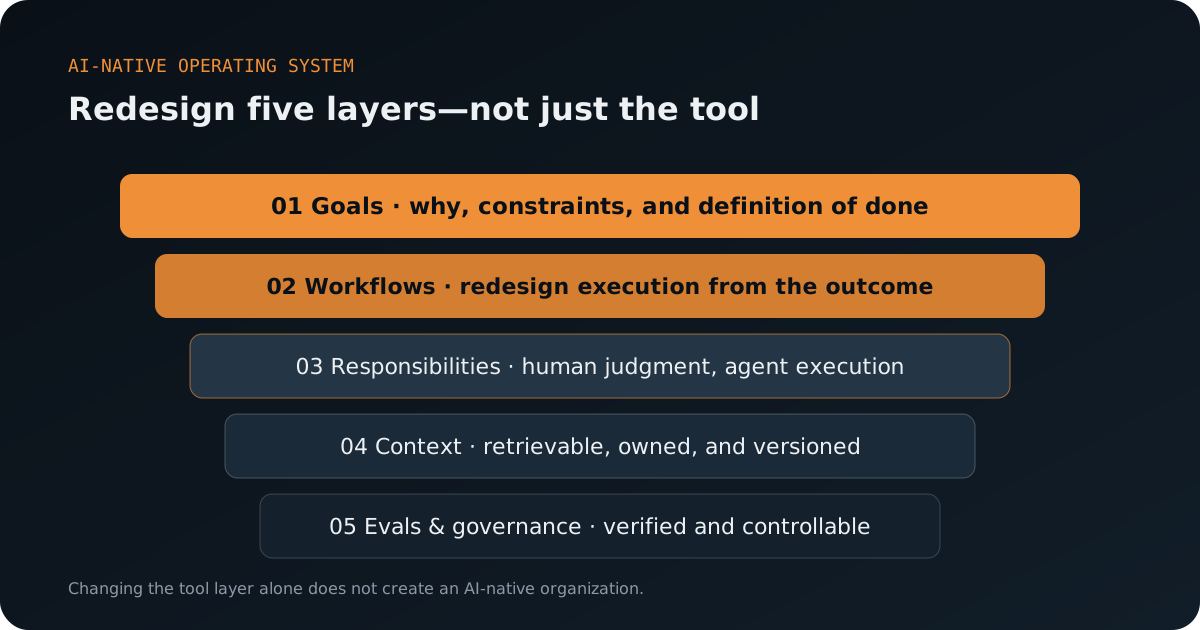
1. Goals
Agents can execute the wrong objective with remarkable efficiency. Clear objectives therefore matter more, not less. Every task needs a problem, an intended beneficiary, constraints, and an acceptance test.
“Research our competitors” is not an executable goal. “Compare the pricing, core workflow, and recurring customer complaints of three competitors; recommend two differentiated hypotheses for next quarter; cite the evidence behind every conclusion” is much closer.
2. Workflows
Do not insert AI into one step of an inherited process. Work backward from the result. Which steps can run in parallel? Which information can be collected automatically? Which judgments must remain human? How does the process degrade? Where does the output go next?
3. Human-agent responsibilities
The useful question is not “Which job will AI replace?” It is “How should judgment and execution be divided inside each job?”
People are better positioned to own goals, taste, priorities, responsibility, relationships, and high-risk exceptions. Agents are well suited to search, synthesis, generation, batch execution, state synchronization, and work with clear verification.
4. Organizational context
If every new session requires an explanation of the company, product, vocabulary, and past decisions, the organization has hired an intern who loses all memory every morning. Principles, domain language, processes, decisions, examples, counterexamples, and permissions must become retrievable and maintainable context.
5. Evaluation and governance
Without evaluation, the team can only say that work “feels faster.” Without governance, greater speed merely spreads errors faster. Evaluation, authorization, audit, fallback, and human escalation must be designed with the workflow.
The new unit of work: a person with agents
Traditional organizations expand execution capacity by adding people and layers. Information moves through managers, and coordination cost rises with headcount.
An AI-native organization increasingly consists of small human-agent units. A product leader may coordinate research, data, prototyping, and writing agents. A developer may delegate repository exploration, implementation, testing, and documentation. The person retains ownership of the objective while agents multiply execution bandwidth.
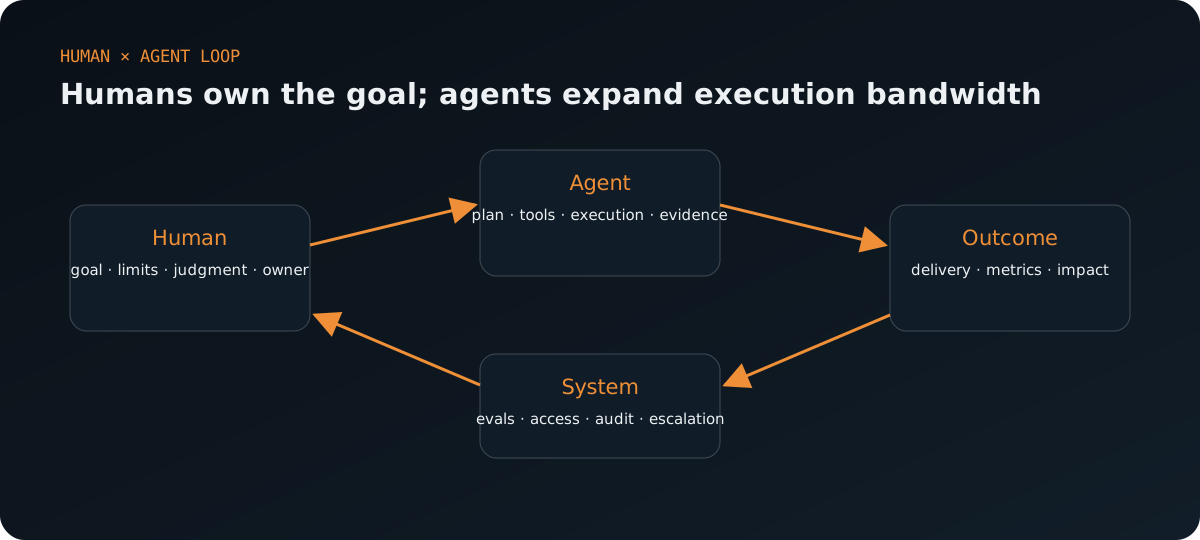
The important variable is not the number of agents. It is clarity of responsibility:
Human: define goals → set boundaries → review critical judgment → own the outcome
Agent: plan → use tools → execute → submit evidence
System: record → evaluate → enforce permissions → trigger escalation
Teams often build a complex multi-agent network too early. A deterministic workflow is usually more reliable when the task is well understood. A single agent should remain a single agent unless the work genuinely benefits from parallel specialization, context isolation, or independent verification.
Complexity should be pulled by the problem, not pushed by enthusiasm for the technology.
Six principles for AI-native workflows
1. Begin with acceptance criteria
Define “done” before choosing a model. Tasks with objective checks are strong candidates for agentic execution: tests pass, accounts reconcile, required fields exist, citations resolve, or outputs match a schema.
2. Treat context as capital
Better output comes not only from better models but from better context. Context should be managed like code: sourced, versioned, owned, reviewed, and retired when stale.
3. Prefer simple, composable patterns
Use deterministic code for deterministic work. Invoke models where ambiguity requires judgment. Give an agent control of the path only when the path cannot be known in advance. Simpler systems are easier to evaluate, debug, and operate economically.
4. Match autonomy to risk
Low-risk, reversible, verifiable actions can run automatically. High-risk, externally visible, or irreversible actions require approval. Drafting an internal summary and sending a contract to a customer should not share the same autonomy level.
5. Make every step observable
At minimum, record the objective, context used, model and tool versions, critical decisions, result, human intervention, latency, and cost. Without traces, every production failure becomes guesswork.
6. Turn failure into system memory
If a human correction does not become a rule, example, or evaluation case, the same failure will return. Organizational learning begins when an individual correction becomes a reusable system capability.
Do not begin with an isolated “AI department”
When transformation is delegated entirely to an innovation unit, one of two things usually happens. The innovation team builds impressive demos without understanding operational constraints, or business teams treat AI as somebody else's project and refuse ownership of the outcome.
A healthier structure has four sources of accountability.
Leadership owns direction and boundaries
Leadership defines why the organization is changing, which workflows matter, what risks are acceptable, and how much capacity will be committed. Leaders also need to use the new operating model themselves. A company notices quickly when executives demand AI adoption while continuing to manage through meetings and cascading status reports.
A platform team owns shared infrastructure
This team provides model access, tools, identity, permissions, knowledge, evaluation, cost controls, and safety foundations. It does not own every business use case. Its job is to eliminate duplicated infrastructure work.
Business teams own outcomes
The people closest to a process understand its decisions and edge cases. Business owners need authority to redesign the process and accountability for quality. Responsibility cannot be transferred to a model vendor or platform team.
AI champions accelerate learning
Practitioners inside real teams help colleagues cross the initial barrier, share successful and failed patterns, and connect business needs with platform capabilities. Champions are catalysts, not a new approval layer.
Choose the first workflow carefully
Do not begin with a company-wide mandate. Begin with a real workflow that is valuable and safe enough to learn from.
Prioritize work that is:
- Frequent: it occurs every day or week;
- Time-consuming: much of the effort is search, synthesis, copying, or coordination;
- Verifiable: output quality has a reasonably clear standard;
- Controllable: failure is inexpensive or can be intercepted before action.
A rough prioritization model is:
Opportunity = frequency × time per task × verifiability × reuse ÷ risk
Do not measure only minutes saved. Track first-pass acceptance, rework, escalation, total cost per accepted result, and end-to-end cycle time. Doubling generation speed while tripling review effort is not a win.
Move beyond a prompt library
Prompt templates are useful, but they are only the shallowest layer of organizational context. A mature context system includes:
Principles: how we make tradeoffs and what is prohibited
Domain language: products, customers, metrics, and terminology
Processes: steps, inputs, outputs, and owners
Decision history: what was chosen, rejected, and why
Examples: strong outputs and known failure modes
Tools and permissions: what an agent may read or change
Evaluation sets: real tasks, expected outcomes, and boundaries
This material requires maintenance. Stale context is often more dangerous than missing context because it creates consistently wrong behavior.
Organizational memory is also not equivalent to putting every file into a vector database. Different knowledge has different lifecycles and access levels. Product metrics may change daily, policies monthly, architecture decisions require version history, and personnel data requires strict isolation. Retrieval is the entry point; governance is the system.
Governance is a prerequisite for scale
When an agent can only draft text, the primary risk is content quality. When it can send messages, change production systems, move money, or update customer records, the risk becomes action.
Design permissions around actions rather than around tools:
| Permission | Example | Behavior |
|---|---|---|
| Automatically allowed | Read public sources, draft, run read-only analysis | Execute and log |
| Conditionally allowed | Edit internal docs, run tests, create tickets | Execute when rules pass |
| Approval required | External communication, production changes, financial or contractual actions | Review plan and impact first |
| Prohibited | Bypass audit, expand its own access, read unrelated sensitive data | Hard block |
Every consequential workflow also needs least privilege, complete auditability, an immediate stop mechanism, and a path back to a safe state.
Human escalation is not failure. The dangerous system is the one that does not know when to ask for help. When goals are ambiguous, evidence conflicts, authority is missing, risk rises, or verification fails repeatedly, the agent should pause and hand over completed work, evidence, and the unresolved decision.
A practical 90-day path
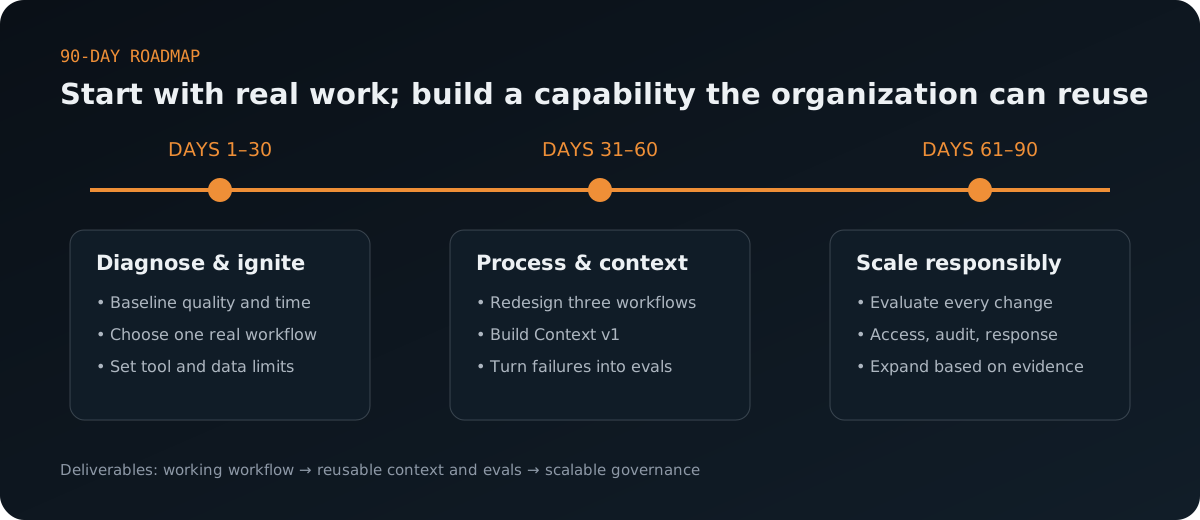
Days 1–30: diagnose and ignite
- Start with one business team, not the entire company.
- Map three frequent workflows and record current quality, time, and cost baselines.
- Standardize two or three tools and publish clear data boundaries.
- Name a business owner, platform partner, and AI champion.
- Redesign one low-risk, frequent, verifiable workflow.
Deliverables: baseline, use-case priorities, tool and data rules, and one working workflow.
Days 31–60: redesign process and context
- Expand to three production workflows.
- Define objectives, inputs, outputs, permissions, and escalation for each.
- Build the minimum organizational context and a library of validated examples.
- Convert real failures into the first evaluation set.
- Review failures as openly as successes each week.
Deliverables: three workflow specifications, context v1, evaluation set v1, and a weekly quality report.
Days 61–90: institutionalize and expand
- Run evaluations whenever models, prompts, tools, or workflows change.
- Establish approvals, audits, cost controls, and incident response.
- Compare cycle time, quality, cost, and escalation against the original baseline.
- Extract reusable components instead of copying entire workflows.
- Use evidence to expand, redesign, or stop each use case.
Deliverables: evaluation dashboard, governance mechanism, quarterly review, and the next roadmap.
Measure outcomes, not AI activity
The number of AI users and tokens consumed are adoption metrics, not value metrics.
More useful measures include:
- Cycle time: from request to accepted outcome;
- First-pass acceptance: results approved without rework;
- Cost per accepted result: model, infrastructure, and human review combined;
- Escalation rate: where people repeatedly need to intervene and why;
- Recovery time: how quickly the workflow returns to a safe state;
- Reuse: how often another team can adopt an existing capability;
- Business outcome: revenue, conversion, quality, customer satisfaction, or risk reduction.
Metrics should not be used to prove that AI was the right decision. They should help the organization continuously decide what to automate, what to keep human, and what not to do at all.
AI-native organizations still amplify human judgment
AI will continue to reduce the cost of execution. It will not make the objective correct, create taste, or absorb accountability.
The best teams may not be those with the most agents. They will be the teams that define problems clearly, provide dense and accurate context, verify outcomes quickly, and convert failures into organizational memory.
An AI-native team is therefore not simply a team with fewer people.
It is a way to execute human judgment at greater scale while keeping the system controllable, verifiable, and accountable.
I did not install every old tool on that new computer. They had not become worthless. My role had moved from operating each tool to designing a system in which people and AI could work together.
For an organization, becoming AI-native begins with the same shift.